-1.png)
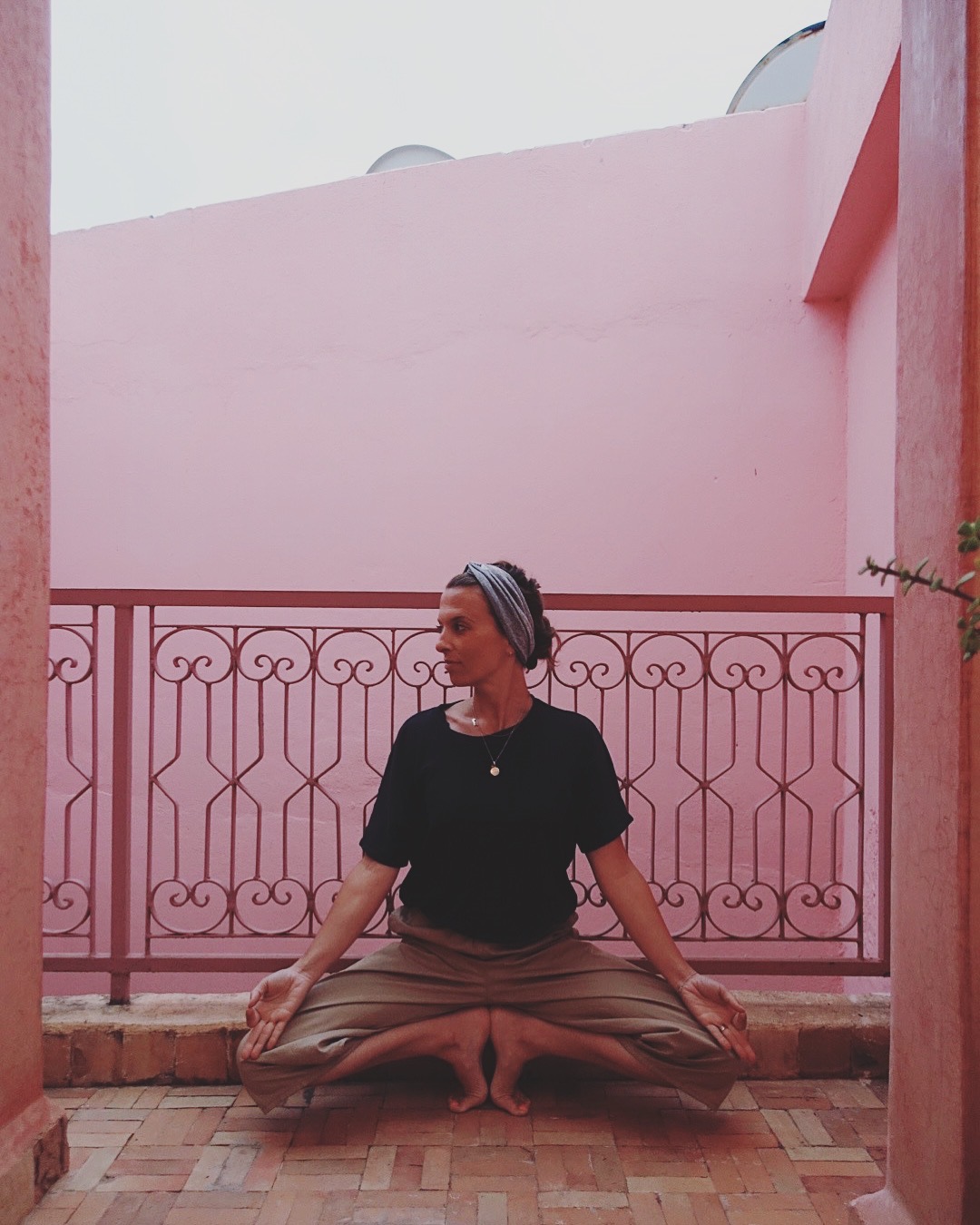
I was thinking recently about a line from Sally Kempton:
“The very heart of yoga practice is abhyāsa, steady effort in the direction you want to go.”
Abhyāsa is a teaching I have returned to many times over the years, in practice, study and teaching. And still, familiar teachings have a way of showing us something different depending on where we are in life.
This time, it was the word direction that stayed with me.
Because when we think about practice, we so easily think about progress.
Am I getting stronger?
Is my practice becoming more advanced?
Can I do the posture yet?
Can I sit for longer?
Why does something that felt easy last month suddenly feel difficult again?
But yoga may be asking us a different question.
Not:
How far have you come?
But:
In what direction are you moving?
Patañjali introduces abhyāsa very early in the Yoga Sūtras.
In Yoga Sūtra I.12, he tells us that the movements of the mind are quietened through two things: abhyāsa and vairāgya.
Practice and non-attachment.
In the following sūtras, abhyāsa is described as the effort to become established in steadiness. Patañjali then adds that practice becomes firmly rooted when it is cultivated for a long time, without interruption, and with sincere dedication.
There is something very grounding in that.
A long time.
Again and again.
Not only when we feel inspired.
Not only when the body cooperates.
Not only while we can see obvious results.
We live in a world that rewards speed. We are used to measuring improvement, collecting achievements and wanting to know whether something is “working.”
Yoga asks for patience.
In the beginning, some changes may come quickly. The body becomes stronger or more mobile. We begin to understand the postures. The breath becomes easier to follow. The mind may feel quieter after practice.
These things matter.
But if we stay with yoga long enough, practice begins to show us something less obvious.
We start to notice not only what the body can do, but what the practice is cultivating in us.
And that is a very different measure of progress.
Kempton’s words could easily be read as general motivation: decide where you want to go and keep working toward it.
Within yoga, though, the direction is more specific.
It is the direction of Yoga itself.
Toward greater clarity.
Toward a mind that is less pulled around by every thought, memory, fear, desire or reaction.
Toward seeing more clearly.
Toward greater freedom from the patterns that keep repeating themselves.
So one of the questions we can occasionally ask ourselves is not simply:
Am I practising enough?
But:
What is my practice cultivating in me?
That question can be uncomfortable.
If years of practice make me more impatient with beginners, what direction am I moving in?
If achieving a posture makes me feel superior, what has the posture really taught me?
If someone practising beside me progresses faster and I become frustrated, what am I actually practising in that moment?
If I become so attached to my routine that any interruption disturbs me completely, has practice made me freer?
These are not questions I ask from some place of having figured them all out. They are questions worth returning to.
Because it is possible to practise a lot and still feed the very patterns yoga is inviting us to see.
We can become attached to postures.
We can compare ourselves constantly.
We can push through signals that deserve our attention.
We can turn yoga into another place where we try to prove something.
None of this makes āsana unimportant.
It simply reminds us that the posture itself is not the destination.
The shape may be visible from the outside.
The direction is much more subtle.
We can easily mistake consistency for depth.
Someone may practise six days a week, know an advanced sequence and have a beautiful physical practice.
None of those things tell us very much about what is happening inwardly.
And the opposite is also true.
Someone working with a simple practice, quietly and attentively, may be practising with great depth.
Yoga does not ask us to become impressive practitioners.
It asks us to pay attention.
What happens in the mind when the posture does not work?
What happens when we are tired?
What happens when somebody else can do something we cannot?
What happens when our body changes and the practice we once knew no longer fits in exactly the same way?
This is where the mat becomes interesting.
Because we are not only practising postures.
We are meeting ourselves inside them.
Abhyāsa asks for steadiness, but steadiness is not the same as repeating the exact same thing forever.
Bodies change. Circumstances change. Life changes.
What serves us at one stage may need to be adapted at another.
The direction can remain steady even when the form of the practice changes.
That distinction matters.
Because the purpose is not to preserve a particular version of our practice at all costs.
The purpose is to keep practising Yoga.
Patañjali does not give us abhyāsa alone.
He places it beside vairāgya, non-attachment.
I find this pairing beautiful.
Practise sincerely.
But loosen your grip on what the practice should give you.
Show up.
But do not demand that today feels like yesterday.
Make an effort.
But do not make your worth dependent on the outcome.
Without abhyāsa, we may keep waiting until we feel motivated.
Without vairāgya, practice can become another form of grasping.
Together they create another quality.
Steady effort without forcing.
Commitment without obsession.
A clear direction without needing to control exactly how the path unfolds.
To me, that comes much closer to the heart of practice.
After years of yoga, I find myself increasingly interested in the ordinary practices.
Not only the beautiful ones.
Not only the mornings when the breath flows easily and the body feels open.
The other ones too.
The stiff ones.
The distracted ones.
The days when the mind has already produced ten convincing reasons not to practise.
And still, you begin.
You place your feet on the mat.
You breathe.
You move.
Maybe nothing extraordinary happens.
No breakthrough.
No profound insight.
No posture suddenly becomes available.
You simply practise.
And another day, you do it again.
We may underestimate these apparently uneventful moments.
A practice is built quietly.
Breath by breath.
Repetition by repetition.
Return by return.
One of the most important things we rehearse on the mat may simply be this:
returning.
The mind wanders.
Return to the breath.
You begin comparing yourself to somebody else.
Notice it and return.
Frustration comes up.
Notice it and return.
You become caught in what the posture should look like.
Return to what is actually happening.
Again and again, yoga gives us the opportunity to notice that we have wandered and begin again.
There is no need to make a drama out of having wandered.
That too is part of practice.
Over time, this may begin to follow us away from the mat.
We notice ourselves reacting and there is a little more space before we speak.
We recognise an old pattern sooner.
We notice fear underneath a decision.
We catch ourselves believing a thought that does not deserve quite so much authority.
We become a little better at seeing what is happening before immediately becoming it.
These changes are difficult to photograph.
They do not look impressive.
But they may tell us far more about the direction of our practice than any posture ever could.
Not because yoga demands perfection from you.
It does not.
And not because every practice has to feel meaningful.
It won’t.
Practise because returning matters.
Practise when it feels beautiful.
Practise when it feels ordinary.
Practise when motivation is there.
And practise, when you can, without waiting for motivation to arrive.
My own practice has changed many times over the years, and I do not write this from some imaginary place of perfect steadiness. Life interrupts us. We change. Our bodies change. Our understanding changes.
Still, the invitation remains.
Return.
Orient yourself again.
Toward awareness.
Toward clarity.
Toward freedom.
That is the direction.
So before the mind comes up with too many reasons not to, roll out your mat.
Begin with one breath.
You do not have to travel very far today.
Just remember the direction.
See you on the mat for your urban exhale.
Namas-té,
Ine
